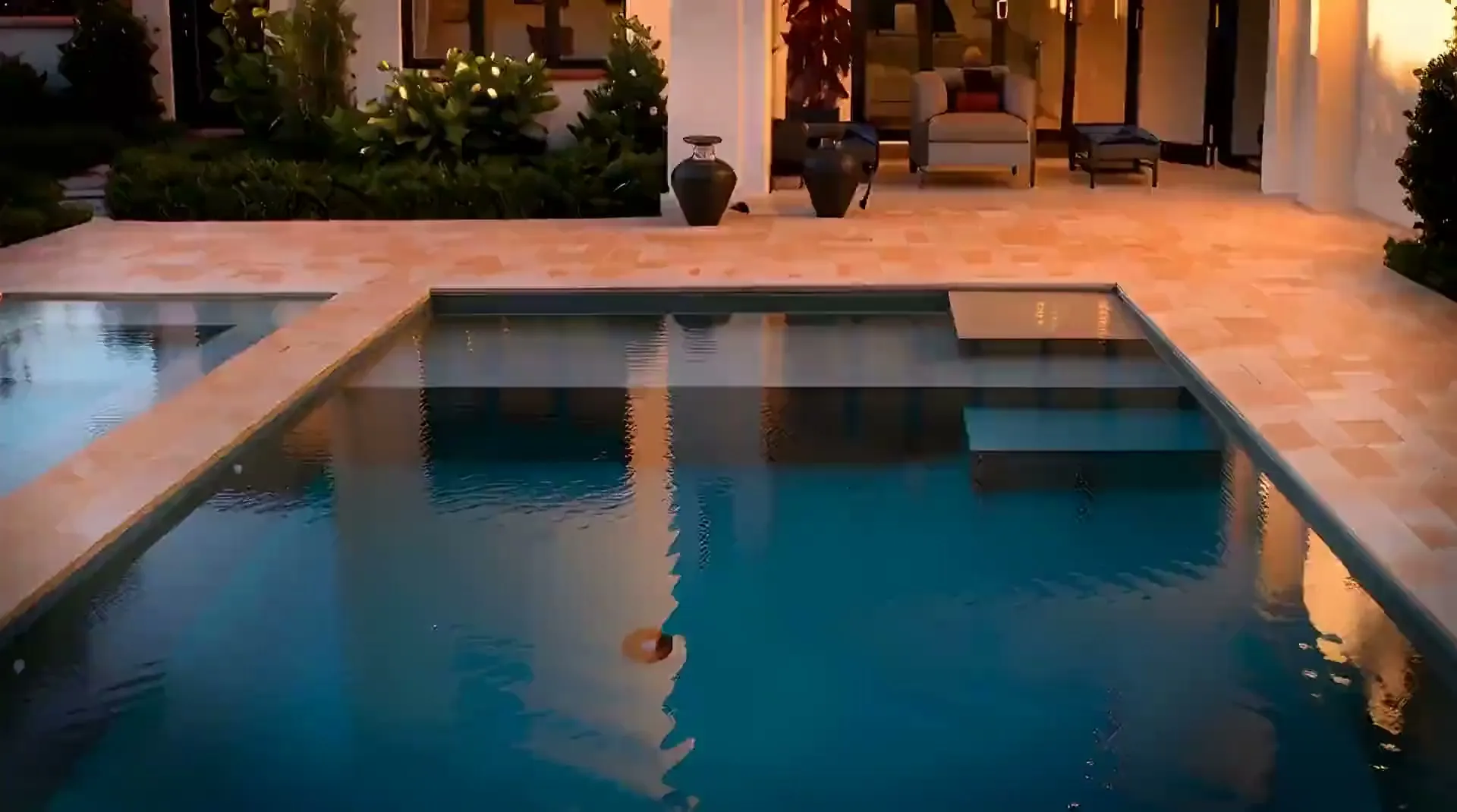

NAPLES, FL · DECK MAINTENANCE
Cleaning a pool deck, without taking years off it
Pressure washing is the most common maintenance a pool deck gets in this county and the most common way one is quietly damaged. The equipment is easy to rent, the result looks immediate, and most of the harm happens somewhere you cannot see it on the day.
In short
What this work actually involves
Pool deck cleaning is the removal of algae, organic growth and surface soiling from the deck around a pool, usually by pressurized water and a cleaner. Done correctly it is routine maintenance. Done at the wrong pressure, with the wrong cleaner, or immediately before sealing, it strips joint sand, etches stone and traps moisture under a finish.
Part one
How often does a Naples pool deck actually need cleaning?

More often than a deck in a dry climate and less often than most people are sold. There is no published interval, because the driver is not the calendar. It is how much shade, irrigation overspray and standing organic material a particular deck lives with.
A deck under mature oaks on the north side of a house, watered daily by a misaligned zone, will grow a biological film in a season. The same material on an open south-facing pool cage two streets away can go years looking clean. Any company quoting a fixed annual schedule before seeing the deck is quoting a route, not a condition.
The honest test is traction rather than color. Organic growth on a wet deck is a slip surface before it is an eyesore, and it is usually detectable underfoot earlier than it is obvious to the eye. If the deck is slick when it is wet and not when it is dry, that is growth rather than staining, and it is the thing worth removing.
Discoloration is a separate question with separate causes, and a good deal of what gets attributed to a dirty deck in Southwest Florida is metal coming out of the screen enclosure above it rather than anything growing on the surface. That mechanism is set out in why pool staining here is usually not your water, and it matters because washing does not fix a source that keeps depositing.
Part two
What pressure is safe, and where does that number come from?
For interlocking concrete pavement the trade association publishes a range. A high pressure sprayer applies cleaner and water between 1,000 and 4,000 psi, at 2 to 6 gallons per minute. Technique matters as much as the dial: a wide nozzle at a low angle of attack.
The Concrete Masonry and Hardscapes Association specification is explicit on both halves. On pressure, a high pressure sprayer applies cleaner and water between 1,000 and 4,000 psi and at a rate between 2 and 6 gallons per minute. On technique, a nozzle that creates a wide spray enables a large area to be covered efficiently and prevents sand from being washed from the joints, and a low angle of attack from a wide nozzle spray will also reduce the risk of dislodging joint sand (CMHA PAV-TEC-005) [1].
Read those two sentences together and the useful conclusion is that the damage most people worry about is not really a pressure problem. It is a geometry problem. A narrow zero degree tip held close and square to the surface will cut joint sand out at a pressure well inside the published range, and a wide fan held at a shallow angle will clean at the same pressure without doing it.
There is a gap here worth naming rather than papering over. That range was published for concrete pavers. Most Naples pool decks are not concrete pavers. They are travertine, shellstone or marble, and no equivalent pressure figure has been published for those by the natural stone trade body. Anyone quoting a precise psi number for travertine is quoting the concrete number and hoping, and the correct answer for stone runs through the cleaner rather than the pressure.
For a small residential area the association also notes that adequate cleaning can be achieved without professional equipment at all, by applying cleaners by hand, scrubbing with brass or plastic bristles, then rinsing with a garden hose [1]. On a courtyard sized deck that is frequently the lower risk route.
Part three
Why does the cleaner matter more than the pressure on a stone deck?
Because travertine, marble and shellstone are calcium carbonate, and calcium carbonate dissolves in acid. The Natural Stone Institute is direct about it: products containing lemon, vinegar or other acids may dull or etch calcareous stones. Pressure leaves a mark. Acid removes material.
This is the failure that is genuinely hard to reverse. A deck cleaned at slightly too much pressure looks over-cleaned and weathers back. A calcareous deck washed with an acidic cleaner has had its surface chemically removed, and the dulled, slightly rough patch left behind holds dirt more readily than the surface around it, which is why the etched area starts looking dirty faster than everything else afterwards.
The trap is that the acidic products are the ones sold for exactly the problems a Florida deck has. Efflorescence removers and rust removers are acid based by design, and on concrete pavers they are appropriate, applied with a low pressure pump spray at 30 to 100 psi [1]. Move the same bottle onto travertine and it is doing something entirely different to the material.
For the routine case the Natural Stone Institute gives a plain instruction for exactly this setting: in outdoor pool, patio or hot tub areas, flush with clear water and use mild bleach solution to remove algae or moss [2]. It also warns that scouring powders or creams often contain abrasives that may scratch certain stones, so the mechanical shortcut carries its own cost.
One safety point that belongs in any document that mentions bleach. Do not mix ammonia and bleach. That combination creates a toxic and lethal gas [2]. Household cleaners do not always announce which of the two they contain, so the rule is one product at a time and a rinse in between, not a mixture that seems likely to work harder.
Part four
What does washing do to joint sand, and why do decks sink afterwards?

A paver deck is held together laterally by the sand in its joints. Wash that out and the field loses its interlock, water runs straight into the bedding layer and the base below, and the settlement that follows is read months later as a base failure rather than a cleaning decision.
Joint sand is not cosmetic filler. It is what transfers load from one paver to its neighbors, and the specification treats losing it as a defect rather than a housekeeping matter, which is why the cleaning guidance is written around not dislodging it [1].
The sequence is slow enough to hide the cause. Sand comes out in an afternoon, the joints open, the next wet season sends water down them at volume instead of across the surface, and the bedding and base begin to move. By the time a dish or a rut is obvious, the wash that started it is a year in the past and nobody connects the two. The mechanism, and how the base is supposed to be built, is set out in why paver decks sink and rut.
The practical consequence is that re-sanding is part of cleaning a paver deck rather than an upsell attached to it. A deck that has been washed and not re-sanded has been left in a worse condition than it was found in, however much better it looks on the day.
Stone decks set in mortar do not have this failure mode, which is one of the few maintenance arguments genuinely in their favor. They have a different one: the mortar joints and the setting bed are the vulnerable part, and a jet driven into a failing joint will open it further.
Part five
How long does a deck have to dry before it is sealed?
Longer than a single working day. The specification is unambiguous: the cleaned surface must be completely dry prior to applying most sealers, and it calls for at least 24 hours without moisture or surface dampness before application.
That single requirement is the reason the wash-and-seal package sold as one visit so often produces a cloudy deck. The cleaned surface must be completely dry prior to applying most sealers, and at least 24 hours without moisture or surface dampness should be allowed before application (CMHA PAV-TEC-005) [1]. Sealing the same afternoon puts a film over water that has nowhere to go.
Twenty four hours is also a floor rather than a target, and it is written as 24 hours without moisture. In a Naples wet season, an afternoon storm on hour twenty resets the clock. A deck that has been rained on, or run over by irrigation overnight, has not had its 24 hours simply because a day has passed on the calendar.
Whether the deck should be sealed at all is a separate decision from how it is cleaned, and it is not automatically yes. That argument, including what the haze actually is and when the money is better kept, is made in full on paver sealing.
Part six
What about the tile at the waterline?
The white band on waterline tile is scale, and scale is a water chemistry outcome rather than a cleaning failure. Scrubbing removes the deposit. It does nothing about the condition that put it there, so it returns on the same schedule it did before.
The National Plasterers Council sets the balance the water is supposed to hold: pH of 7.2 to 7.8, carbonate alkalinity of 80 to 120 ppm, and calcium hardness of 200 to 400 ppm [3]. Scale forms when the water sits above that, with high pH or elevated levels of alkalinity, calcium hardness or total dissolved solids, or a combination of them.
The reverse is the more expensive direction and gets less attention. Water low in pH, carbonate alkalinity or calcium hardness is corrosive, and the NPC names what it goes after: it can destroy pool tile grout, metal light rings, heaters, and pool equipment [3]. A pool being scrubbed regularly and topped up with soft water can be losing grout while it looks well maintained.
Local fill water pushes in that second direction rather than the first, which is not what most Florida advice assumes. What comes out of the tap in this county, and why a new finish is the thing most at risk from it, is measured in why Collier County tap water is hard on a new plaster finish.
Where the tile is coming off rather than fouling, cleaning is beside the point, because the failure is behind the tile rather than on it. That is waterline tile replacement, and the reason it recurs after a re-tile is covered in why waterline tile comes off.
Part seven
What does a realistic maintenance year look like here?
Two seasons, not four. The wet season grows things and moves water. The dry season is when work that needs a dry surface is possible at all. Sequencing the year around that is most of what separates a deck that ages slowly from one that does not.
Through the wet season the useful jobs are the ones that cost nothing. Keep irrigation off the deck, because a misaligned zone is the single most reliable way to grow a slip surface and to keep a joint permanently damp. Clear organic debris rather than leaving it to sit, since a leaf mat holds water against the surface and is where growth starts. Neither of those is billable work and both do more than an annual wash.
The dry months are when cleaning and any sealing belong, for the plain reason that the 24 hour dry requirement is achievable then and is a gamble in August [1]. That is also the window when a deck can be looked at properly, because a dry deck shows settlement, lippage and open joints that a wet one hides.
Once a year, walk the perimeter where the deck meets the pool. The flexible joint there is a consumable and it is the entry point for most of the water that causes expensive problems, which is the argument made in why pool coping comes loose. A joint that has hardened, shrunk or split is a maintenance item while it is still a joint, and a structural one once water has been through it for a couple of seasons.
What does not belong on an annual schedule is sealing. Reseal intervals are driven by the product and the exposure rather than the calendar year, and treating sealing as annual maintenance is how a deck ends up with more film on it than the surface can hold.
Part eight
When is cleaning not the answer?
When the deck is moving, when the joints are open because the base has gone rather than because the sand washed out, and when the discoloration has a live source above it. In all three cases a wash buys a few weeks and delays the diagnosis.
The pattern is the tell. Isolated dishes and stripes usually point at a local cause. Broad unevenness across several areas points at how the deck was built. Neither is improved by being clean, and the distinction, along with what the base should have been, is drawn out in why paver decks sink and rut.
Where pavers have already settled or concrete has cracked, the work is lifting and resetting on a corrected base rather than surface treatment, which is pool deck repair. Where the deck ties into a pool that is being worked on anyway, the sensible sequence is to settle the deck question before the finish and tile go in, which is how pool decks and pavers is scoped alongside the rest of a remodel.
And where the deck is sound but the material is wrong for how the household actually uses it, cleaning is not the lever either. Surface temperature is a material and color question before it is a maintenance one, compared in travertine, marble or porcelain, with the stone options at travertine and natural stone decks.
Choose the surface
Which deck surface fits how you live outside?
Four surfaces do most of the work in Collier County. They differ less in looks than in how they behave in August, wet, and ten years in.
- Barefoot in August
- Among the coolest choices. The stone breathes, so it sheds heat instead of banking it.
- Wet grip
- Naturally textured surface; tumbled finishes grip well around spillovers and steps.
- Salt air
- Happy near salt, but it is porous, so sealing decides how it ages.
- Upkeep
- Periodic resealing. Skip it and the pores start holding stains instead of shrugging them off.
The default for a reason: barefoot comfort and a look that matches the Naples build era.
- Barefoot in August
- Cool underfoot, close to travertine. Light colors matter more than the stone.
- Wet grip
- Depends entirely on the finish. Polished marble near water is a mistake; sand-blasted or tumbled is not.
- Salt air
- Dense and durable, but acids etch it. Chlorine splash and the wrong cleaner both leave marks.
- Upkeep
- The most particular of the four. It rewards owners who keep to a sealing schedule.
The formal choice. Crisp veining and a brighter deck, for owners who will maintain it.
- Barefoot in August
- Runs warmer than stone in dark colors; pale tones stay reasonable.
- Wet grip
- Manufactured with a rated slip texture. The most predictable wet surface of the four.
- Salt air
- Effectively immune. Nothing for salt or chlorine to get into.
- Upkeep
- The lowest of the four. No sealing; rinse it.
The modern, low-maintenance pick. Clean lines and color that does not shift over the years.
- Barefoot in August
- The warmest of the four, especially in the popular darker blends.
- Wet grip
- Good texture out of the box; smooths gradually where the traffic is.
- Salt air
- Fine structurally, but color is a surface layer. Coastal sun and salt fade it first.
- Upkeep
- Sealing keeps the color; joint sand wants topping up every few seasons.
The workhorse. The widest range of shapes and patterns, and the easiest to repair one paver at a time.
Straight answers
Questions Naples owners actually ask
 Clayton Waggoner Owner, Splash Pools LLC
 Clayton · Owner
On a small area, yes, and the trade specification says so directly: adequate cleaning can be achieved without professional equipment by applying cleaners by hand, scrubbing with brass or plastic bristles, then rinsing with a garden hose (CMHA PAV-TEC-005) [1]. If you do use a machine, the two things that matter are a wide nozzle and a low angle of attack, because a narrow tip held square to a paver joint will strip the sand out of it at any pressure in the normal range. Clayton · Owner
It removes what is sitting on the surface. It does not remove a stain that is being fed. In Southwest Florida a large share of deck discoloration comes from fasteners and framing in the screen enclosure above corroding and rinsing down, so the deposit returns after every rain until the source is dealt with. That mechanism is set out in pool staining in Southwest Florida. Clayton · Owner
The Natural Stone Institute names it for this exact setting: in outdoor pool, patio or hot tub areas, flush with clear water and use mild bleach solution to remove algae or moss [2]. The important caution is not the bleach itself but combining products. Do not mix ammonia and bleach, because that combination creates a toxic and lethal gas [2]. Use one product, rinse, and do not improvise a stronger mixture. Clayton · Owner
Most often because the two happened too close together. The cleaned surface must be completely dry before most sealers go on, and the specification asks for at least 24 hours without moisture or surface dampness [1]. Sealing over a damp substrate traps water under the film, and the milky appearance is that water. The related failure, over-application, is covered on paver sealing. Clayton · Owner
Those products are acid based, which is appropriate on concrete pavers and a problem on stone. Travertine, marble and shellstone are calcium carbonate, and the Natural Stone Institute is explicit that products containing lemon, vinegar or other acids may dull or etch calcareous stones [2]. Etching removes material rather than marking it, so it is not something a second cleaning corrects. Clayton · Owner
No. Draining a pool in this region is a decision with its own risks and is almost never warranted for deck work. Runoff is the thing to manage, since cleaners and the material they lift both end up somewhere, and where that water is allowed to go is separately regulated in Florida. That is covered in where a drained pool can legally go. Clayton · Owner
That depends on the product and the exposure rather than a fixed year count, and it is a different decision from cleaning. Sealing is not automatically worthwhile on every deck in this climate. The full argument, including when the money is better kept, is on paver sealing in Naples.Talk to Clayton
Send the details, get a call back.
A sentence or two is enough. You get a call back from the person who does the work, not a dispatcher.
Service area
Where we work
Click any marker. What fails is genuinely different from one neighborhood to the next, and the card says which.
Where we work
Naples and Collier County, plus Marco Island, Bonita Springs and Estero. What fails is different in each, and that is what decides the work.
- Port Royal waterfront, architectural review, deck must match the house
- Old Naples pools built in the seventies and eighties, due for everything at once; original skimmers
- Aqualane Shores canal homes, deck movement near the seawall separates coping
- Park Shore Gulf Shore Boulevard salt air hits the tile line first; seasonal vacancy
- The Moorings direct salt air exposure, waterline tile failure
- Coquina Sands seventies and eighties pools; decks poured over uncompacted fill
- Royal Harbor canal homes, high water table hides leaks; coping separation
- Grey Oaks gated architectural review on anything visible from the street; spa additions
- Quail West natural stone decking matched to the house; spa additions
- Pelican Bay empty April to November; automation and heat pumps for year-round swimmers
- Lely Resort natural gas supply; builder decks aging out; year-round pump runtime
- Fiddler's Creek natural gas heater sizing; builder-era paver decks losing their base
- The Vineyards year-round swimming, heat pumps and variable speed payback
- Naples Park mature landscaping into pool plumbing; original skimmers; storm-loaded filters
- Pine Ridge Estates mature landscaping finds underground pool plumbing
- Vanderbilt Beach equipment pads corrode fast; storm season loads filters
- Golden Gate Estates well water iron staining on marcite; propane rather than natural gas
- Isles of Capri canal water table hides leaks; heavy equipment-pad corrosion
- Marco Island barrier island salt air corrodes heaters from the inside out
- Bonita Springs pool decks and patios on Southwest Florida soil
- Estero deck and patio base engineered for local soil
- Ave Maria newer east-county builds, patios and walkways matched to existing hardscape
Related services
Paver sealing in Naples, and when to keep your money →Pool deck repair in Naples, and whether resetting will actually hold →Pool deck pavers in Naples, built on a base that lasts →Travertine and natural stone pool decks in Naples →From the insights
Can a cracked pool deck be resurfaced, or does it have to come out? → Ready when you are
Tell us what the pool is doing.
A sentence or two is enough. You get a call back from the person who does the work, not a dispatcher.