
Insights · Naples and Collier County
Can a failing seawall damage the pool and deck on a Naples canal lot?
On a canal lot the backyard ends at a concrete wall, and everything between the house and that wall, the pool and its deck included, sits on soil the wall is there to hold in place. It is easy to think of the seawall as the boat's business and the pool as a separate thing. They share the same ground. When a seawall starts to fail, some of the signs show up in the yard. This is what the official seawall manual and the local codes say about that, and what to check before a pool remodel on the water.
 Clayton Waggoner, Owner and Managing Member, Florida license CPC1461352 · Published November 19, 2026 · 15 min read
A seawall is the vertical wall that separates a waterfront lot from the canal or bay beside it. The City of Marco Island's seawall manual says these walls are meant to keep "land in" rather than "water out", and describes them as panels, a concrete cap, tieback rods and buried concrete anchors called deadmen (City of Marco Island, 2018)1.
The short version
Can a failing seawall damage the pool and deck on a Naples canal lot?
The mechanism is simple to describe. A canal seawall is a row of panels with soil packed behind it, held upright by steel tieback rods that run back to buried concrete blocks the manual calls deadmen, placed approximately 15 feet back in the yard (City of Marco Island, 2018)1. On a canal lot, the yard between the house and the wall is that soil, and the pool deck is part of the yard.
When the wall lets soil escape, the manual lists the symptoms: sinkholes upland of the wall, backfill mounds in the water near the joints, most visible at low tide, and backfill settlement where tiebacks are failing (City of Marco Island, 2018)1. What that means for one particular deck is a site question, so this article does not diagnose. It sets out what the City of Marco Island, the City of Naples and Collier County have written, and who each expects to design, inspect and repair a seawall.
What does a seawall actually hold up?
The manual describes the wall as a set of parts rather than one unit: interlocked panels of concrete, composite, PVC or metal, a concrete cap that ties them together, and tieback rods anchored to deadmen in the landside soil (City of Marco Island, 2018)1. It says the tiebacks and deadmen are vital to keep the wall upright and stop it falling into the water.
Water matters as much as soil. The manual calls the pressure difference between the land side and the water side one of the major causes of seawall damage, and describes the French drain as usually a 2 foot by 2 foot trench of crushed stone lined with filter fabric (City of Marco Island, 2018)1. Marco Island's code defines a weep hole as one that drains water through the wall without allowing loss of soil (City of Marco Island Code of Ordinances, 2024)2. Every definition comes back to keeping the land where it is.
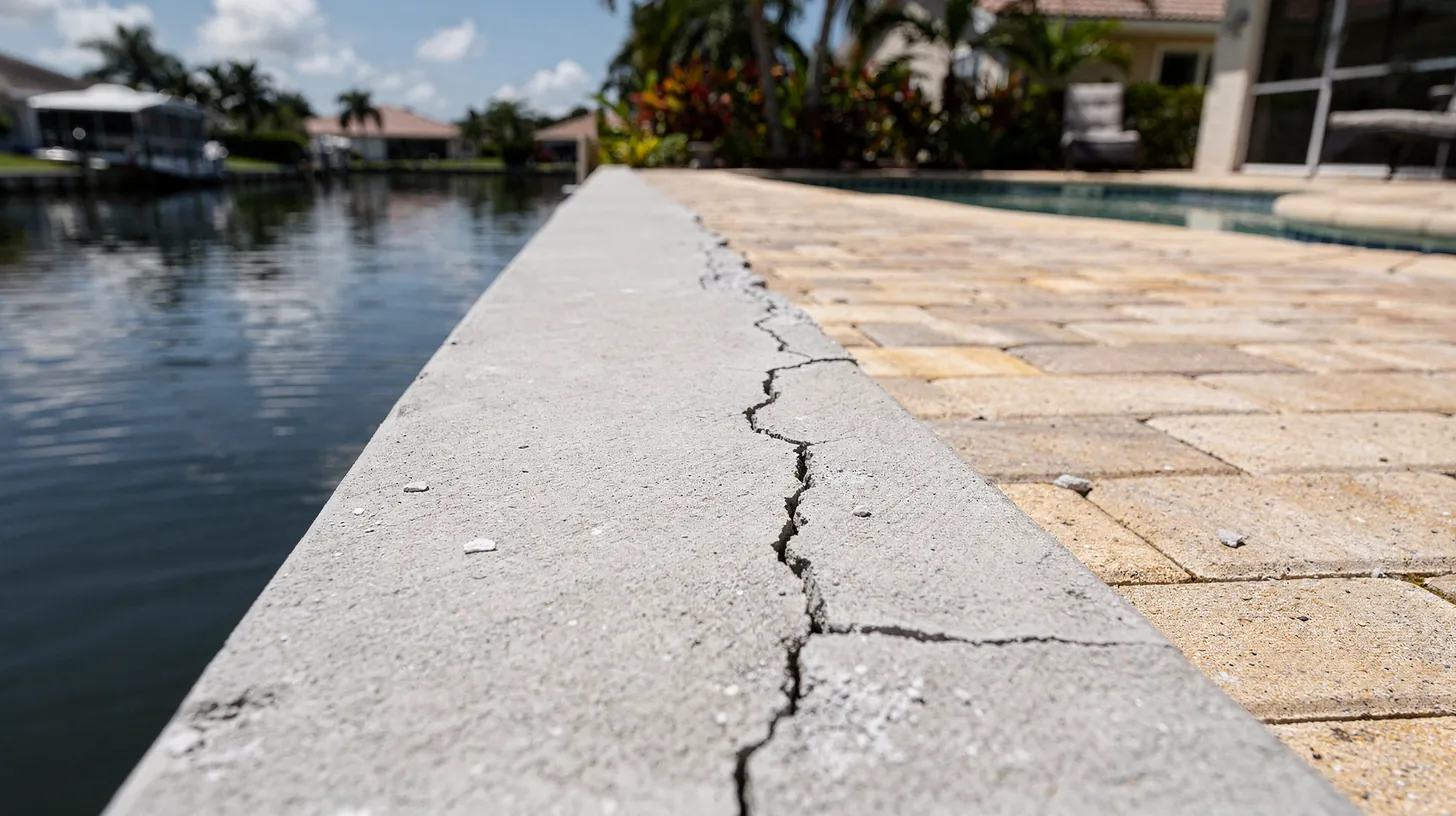
How do seawalls fail, according to the Marco Island manual?
Three of the six list a symptom on the land side: sinkholes upland of the wall, backfill settlement under tieback failure, and sinkholes under slab joint separation. The manual notes that sinkholes frequently occur after heavy rains (City of Marco Island, 2018)1.
The other entries describe the structure itself. When a cap comes apart, the manual says, the tieback rods have no anchor point and there is nothing to hold the vertical walls in alignment (City of Marco Island, 2018)1. When the berm at the bottom washes away, usually from wave action or speeding boats, the panels tilt out toward the canal.
The manual recommends that anyone buying a waterfront home have the seawall evaluated by an engineering firm or a contractor specializing in marine construction first (City of Marco Island, 2018)1. The same reasoning applies before spending money on the pool behind it.
| Problem | Symptoms the manual lists | Causes the manual lists |
|---|---|---|
| Sinkholes | Sinkholes upland of the wall; backfill mounds in the water near the joints, most visible at low tide | Age, settling, structural failure, too little berm at the toe, slab separation; frequently after heavy rains |
| Tieback failure | Deteriorating cap, wavy or sagging panels, cracks or spalling, backfill settlement | Salt water corrosion of the cap reinforcing or the tieback rods, or movement of the structure |
| Slab joint separation | Sinkholes, open seams, rock and sediment piled at the base of the joint | Age, uneven hydrostatic pressure at low tide, tieback failures |
| Toe and berm failure | Cap rotation or cracking, a gap opening between the wall and the dock, pilings tight against the wall | Loss of the supporting berm at the bottom of the panels, usually from wave action or speeding boats |
| Waterline failure | Cracking with rust marks on the panels facing the water | Aging, corrosion of concrete and reinforcing rod, uneven hydrostatic pressure |
| Cap failure | Rust, spalling, exposed rebar, fractures | Aging, corrosion of concrete and reinforcing rod, uneven hydrostatic pressure |
Which seawall problems show up in the yard and on the pool deck?
Where to look follows from the manual's list. Walk the land side of the wall for depressions or holes, especially after heavy rain, and at low tide look at the water side of the joints for mounds of rock and soil (City of Marco Island, 2018)1. The manual puts the deadman approximately 15 feet back in the yard (City of Marco Island, 2018)1, and Marco Island makes it unlawful to place an in-ground pool waterward of the anchors or within 15 feet of an existing seawall (City of Marco Island Code of Ordinances, 2024)2. A deck that has settled toward the canal is worth pointing out to whoever evaluates the wall.
Decks and pools also move without any help from a seawall. Why paver pool decks sink and rut covers the base under a deck, and whether a pool crack is structural or cosmetic covers the shell. The reason to look at the wall first is to avoid rebuilding over ground that is still moving. Once the cause is known, the pool deck repair page and the pool crack and shell repair page explain the repairs.
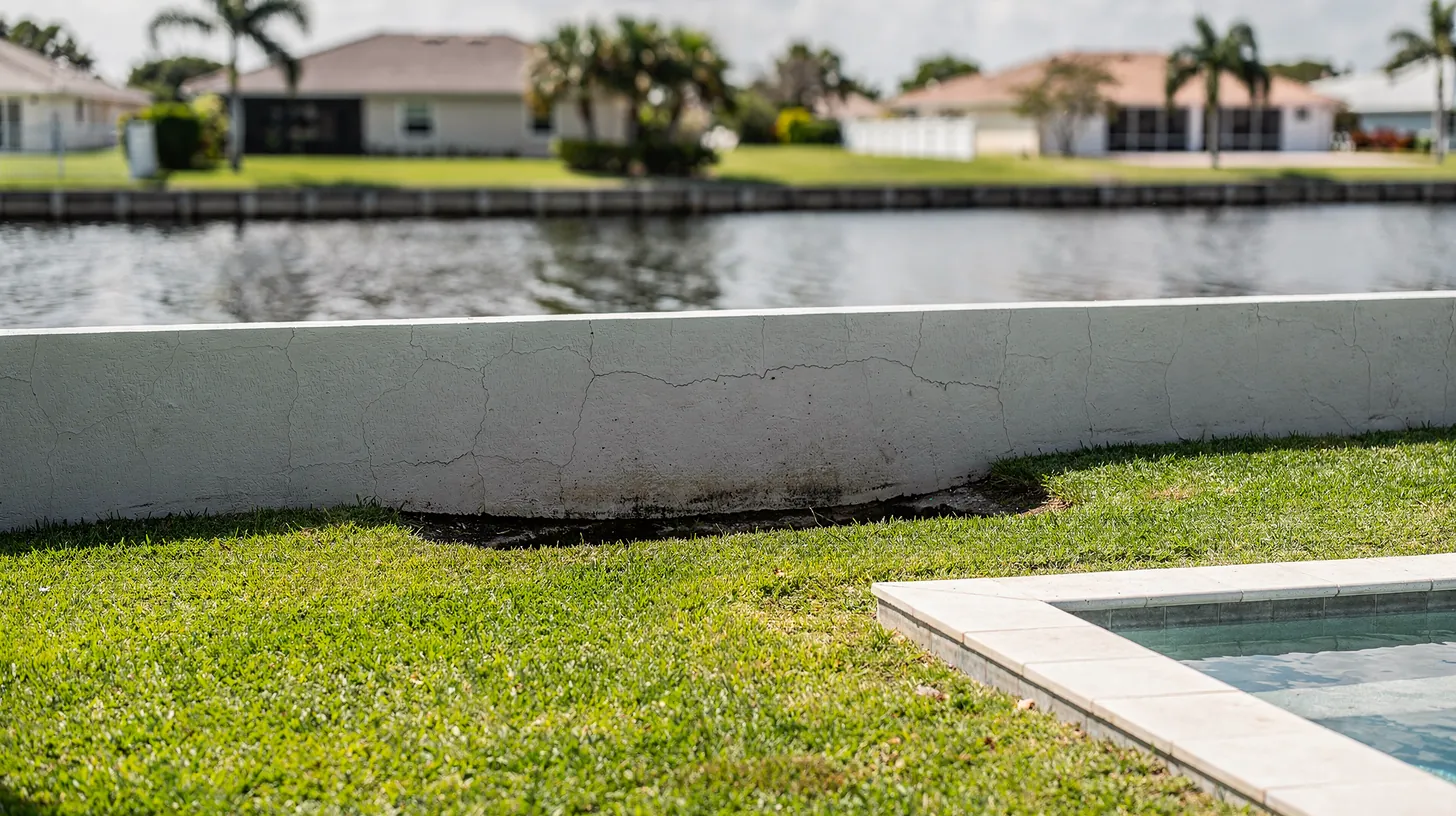
How close to a seawall can a pool be on Marco Island, in Naples and in the county?
Marco Island's Section 6-86 also cautions owners not to plant trees near the wall because the roots can damage it (City of Marco Island Code of Ordinances, 2024)2. Its text speaks of placing a pool, so how it treats a remodel of an existing pool is a question for Marco Island Building Services. Owners on the island can start with the Marco Island pool remodeling page.
The City of Naples measures from the screen enclosure or the water's edge of an unscreened pool (City of Naples Code of Ordinances, 2019)7. Its seawall section adds that where a new wall is placed in front of an old one, setbacks are measured from the property line or the waterside of the original seawall slab, whichever is more restrictive (City of Naples Code of Ordinances, 2015)5.
Collier County's waterfront table gives a one- or two-family pool a 10 foot rear setback where the deck is four feet or less above the top of the seawall, and 20 feet where it is higher (Collier County Land Development Code, 2022)8. Isles of Capri has its own threshold of seven feet, with no more than four feet of stem wall exposure (Collier County Land Development Code, 2022)8. Owners there can read the Isles of Capri pool remodeling page.
| Jurisdiction | What the code says | Measured from |
|---|---|---|
| City of Marco Island | No in-ground pool waterward of the seawall anchors or within 15 feet of an existing seawall (City of Marco Island Code of Ordinances, 2024)2 | The existing seawall and its anchors |
| City of Naples | Unroofed or screened pool no closer than 15 feet to any rear lot line, and not in a utility or drainage easement (City of Naples Code of Ordinances, 2019)7 | The screen enclosure, or the water's edge of an unscreened pool |
| Collier County Land Development Code, waterfront one- and two-family lots | 10 foot rear setback where the pool deck is 4 feet or less above the top of seawall, 20 feet where higher; Isles of Capri uses 7 feet with at most 4 feet of stem wall exposure (Collier County Land Development Code, 2022)8 | The rear lot line, with deck height read against the top of the seawall |
What does the permit office want to see when a pool sits near a seawall?
Marco Island's form puts the pool and the wall on one drawing, and it covers alterations as well as new pools (City of Marco Island Building Services, 2026)3. The seawall's own height is regulated too. Marco Island requires the top of cap on new and replacement walls to sit between 3.2 and 4.2 feet NAVD (City of Marco Island Code of Ordinances, 2024)2, and the City of Naples caps them at 4.8 feet NAVD (City of Naples Code of Ordinances, 2015)5. Both require a return wall where a cap differs from the neighbor's by more than one foot (City of Marco Island Code of Ordinances, 2024)2 (City of Naples Code of Ordinances, 2015)5.
Those numbers matter to a pool remodel because Marco Island's application asks for pool deck elevation and seawall elevation on the same site plan (City of Marco Island Building Services, 2026)3. A separate article covers the flood zone substantial improvement rule, and which office issues the permit at all is covered in pool permits in the City of Naples and on Marco Island.
Who inspects a seawall, and who is licensed to repair one?
Collier County's code describes that contractor as qualified to build and install bulkheads, revetments, docks, piers and similar structures and to do pile driving, after 36 months of experience and two passed tests (Collier County Code of Ordinances, 2002)9. The residential pool/spa contractor in the same section covers the construction, repair and servicing of pools and spas (Collier County Code of Ordinances, 2002)9.
Both cities want a Florida engineer on the design. The City of Naples requires seawall plans by a Florida professional engineer that address all soil and hydrostatic loads over the life of the structure (City of Naples Code of Ordinances, 2015)5, and exempts repair of an existing seawall by grouting, patching or replacement of tiebacks, but not replacement of any section parts, from engineered design (City of Naples Code of Ordinances, 2026)6. Marco Island requires signed and sealed engineered plans for all seawall work beyond minor repairs (City of Marco Island Code of Ordinances, 2024)2.
The manual and the code describe inspection differently. The 2018 manual says the City no longer conducts regular inspections during seawall construction and that City-sponsored inspections are available separately (City of Marco Island, 2018)1. The code as amended in 2024 says construction is inspected by the City or by a licensed Florida engineer, at the building official's discretion (City of Marco Island Code of Ordinances, 2024)2. The manual also notes that owners replacing a seawall may wish to engage their own engineer or a third-party consultant (City of Marco Island, 2018)1.
What happens if the city decides your seawall has failed?
Marco Island calls a seawall failed when it has collapsed or no longer functions to stabilize the shoreline, and lets an owner who disagrees file an independent report certified by a licensed Florida engineer within 60 days (City of Marco Island Code of Ordinances, 2024)2. The City of Naples uses a wall that has failed structurally or does not serve to stabilize the position of the shoreline (City of Naples Code of Ordinances, 2026)6. Neither waits for the wall to fall into the canal.
For a pool owner the practical point is order. A failed-wall notice puts a deadline on the seawall that a pool project cannot set aside, and the manual warns that a sagging seawall next door may cause damage to yours (City of Marco Island, 2018)1. If the wall is anywhere near that line, the wall comes before the pool.
What should you check before a pool remodel on a canal lot?
Start with the address, because each office wrote its own rules. Waterfront neighborhoods such as Port Royal, Aqualane Shores and Royal Harbor each have their own page on this site, and the permit guide linked above explains how to confirm which office covers a lot. Then walk the wall using the manual's list: the cap, the joints at low tide, the waterline, any gap at the dock, and the yard behind it (City of Marco Island, 2018)1. Anything on that list is a reason to call a marine contractor or a Florida engineer before a pool scope is written.
Plan the work around the wall. The manual asks owners to avoid heavy equipment traveling along the seawall perimeter and to redirect yard and roof drainage so it does not flow directly into the French drain or pond behind the wall (City of Marco Island, 2018)1. A pool remodel brings demolition and trucks to the same yard, so ask where equipment will travel and where water will go. Pool deck drainage and standing water covers where a deck's water should end up.
If seawall work is also planned, the manual notes that developed lots often require work from a barge, and that docks, landscaping, sprinklers, exterior plumbing and electric conduits can limit access or need removal and replacement (City of Marco Island, 2018)1. Pool equipment and plumbing near the wall belong on that list of questions.
Ask Clayton
Questions this article usually prompts
Tap a question. Clayton replies himself, here and on the phone.
Tap a question to ask
If this is the situation you are in
Pool deck repair and resurfacing in Naples, and which one your deck needs →Structural crack repair, starting with what is causing it →Pool coping replacement, and the beam underneath it →Pool remodeling in Naples, handled as one project →References
- City of Marco Island, Waterways Advisory Committee, Seawall Manual, Version 5 (May 2018)
- City of Marco Island Code of Ordinances, Chapter 6, Article III, Division 2, Seawalls and Revetments (Secs. 6-81 to 6-87)
- City of Marco Island Building Services, Pool Spa Fountain Permit Application, Form 13
- City of Marco Island Building Services, Seawall Permit Application, Form 31
- City of Naples Code of Ordinances, Sec. 52-92, Water resources generally
- City of Naples Code of Ordinances, Sec. 52-93, Dredging, filling and other marine construction in inland waters
- City of Naples Code of Ordinances, Sec. 56-45, Pools
- Collier County Land Development Code, 4.02.03, Specific Standards for Location of Accessory Buildings and Structures
- Collier County Code of Ordinances, Sec. 22-162, Definitions and contractor qualifications

The article is general.
Your pool is specific.
Tell us what the pool is doing, a sentence or two is enough. The person who wrote this is the person who calls back.