
Insights · Pumps, heaters and automation
How loud can a pool heat pump be in Naples, and where can it sit?
The easy place for a pool heat pump is wherever the pipe run is shortest, and on many Naples lots that is a side yard a few steps from a neighbor's bedroom window. Its fan can run for hours, including at night. Whether that is a problem in law depends on which government your address answers to, because Collier County, the City of Naples and Marco Island each wrote their own noise rules and their own rules for equipment in a side yard.
 Clayton Waggoner, Owner and Managing Member, Florida license CPC1461352 · Published November 20, 2026 · 16 min read
A noise ordinance sets the most sound one property may send onto another, measured with a sound level meter in A-weighted decibels (dBA) at or near the property that receives it. A required yard, or setback, is the strip inside each property line where structures are limited. Pool equipment is one of the few things the codes let into that strip, within limits that differ by jurisdiction.
The short version
How loud can a pool heat pump be in Naples?
The headline numbers are only part of each rule, so read the measuring point in every column. None of the three measures at the heat pump. Each one measures where the sound arrives: at the property line or inside the boundary of the home receiving it (Collier County, 2026)1 (City of Naples, 2026)5 (City of Marco Island, 2026)9. That is why a unit's own sound rating and a code limit are different numbers, a point the section on manufacturer ratings works through.
First, though, you need to know which column you are in. A Naples mailing address alone may not tell you, and who issues your pool permit inside the City of Naples and on Marco Island explains how to tell. The heater itself, sizing and installation, lives on the heat pump pool heater page.
| Rule | Unincorporated Collier County | City of Naples | Marco Island |
|---|---|---|---|
| Daytime limit at a home | 60 dBA, 7 a.m. to 10 p.m. | 60 dBA, 7 a.m. to 10 p.m. | 68 dBA, 7 a.m. to 9 p.m. |
| Nighttime limit at a home | 55 dBA, 10 p.m. to 7 a.m. | 55 dBA, 10 p.m. to 7 a.m. | 60 dBA, 9 p.m. to 7 a.m. |
| Where it is measured | At or within the boundary of the complaining property | At the property line of the receiving property | At the receiving property, at or within its line |
| Background sound test | Must also exceed ambient by at least 5 dB | May not exceed ambient by more than 5 dB | None stated |
| Audibility test | Listening-only rule covers animals, vehicles and sound devices | Plainly audible 25 feet or more from the property line | Plainly audible 50 feet from the source property line, 10 p.m. to 7 a.m. |
| Inside a condo or duplex unit | 53 dBA day, 45 dBA night | No more than 5 dB over ambient in an adjoining unit | 50 dBA day, 45 dBA night |
| Pool equipment named | Equipment includes heating units, pumps and fans | Pool heaters, pool pumps and heat pumps | No equipment section |
| Tone and frequency rules | Limits drop 5 dB for a pure tone | Octave band limits from 31.5 to 8,000 Hz | None stated |
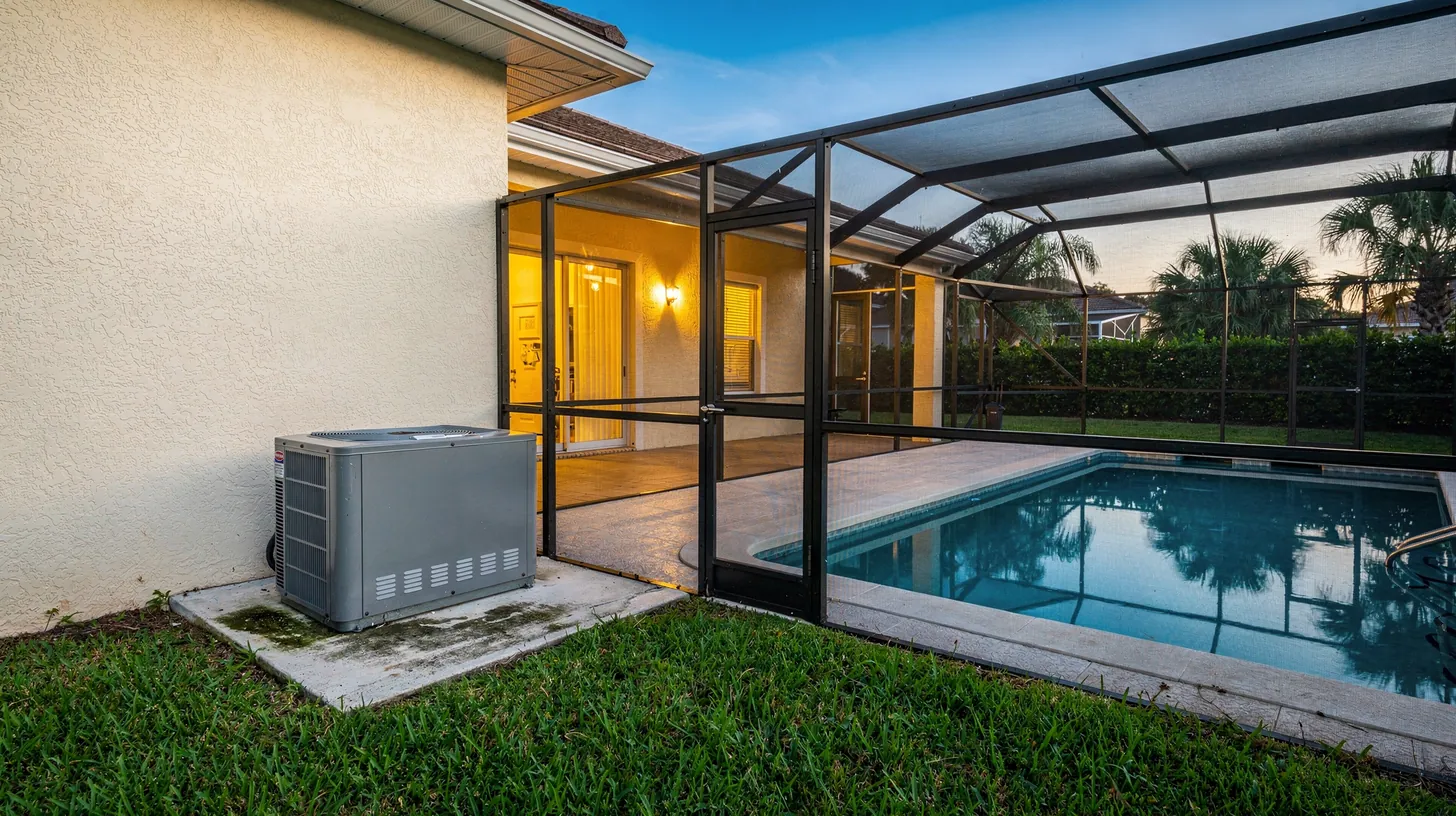
How does Collier County measure a noise complaint?
The rules sit in Chapter 54, Article IV, the Collier County Noise Control Ordinance, which applies to the unincorporated county (Collier County, 2026)1. A complaint needs the complainant's name, address and phone number, and the Sheriff or a designee may test with a sound level meter that meets the Type 2 standard (Collier County, 2026)1.
The test is careful about placement. The meter normally sits more than 50 feet from the source, at least 3 feet off the ground and at least 4.5 feet from walls and other sound-reflecting surfaces (Collier County, 2026)1. The reading compared with the limit is a 60-second equivalent level, corrected for background: if the source beats ambient by only 5 dB, 2 dB comes off the reading, and at 9 dB or more nothing does (Collier County, 2026)1.
One exemption is worth reading closely. Section 54-87 L exempts equipment and activities normal to residential communities between 7 a.m. and 10 p.m., and its examples are lawn care, power tools, mowers and tree work (Collier County, 2026)1. It does not name pool equipment, so treat that as a question for the county and plan as if the limits apply.
What does the City of Naples say about pool heaters and heat pumps?
The City's wording is direct. It prohibits operating any fan, air conditioner, compressor unit, pool heater, pool pump or heat pump whose operation causes excessive and unnecessary noise, unless the noise is muffled enough to minimize annoyance to people within hearing range (City of Naples, 2026)5.
The table goes further than a single number. It also sets a limit for each octave band, from 31.5 hertz up to 8,000 hertz, measured at the nearest point of the receiving property line (City of Naples, 2026)5. A unit that passes on overall dBA can still be tested band by band.
Two more tests stand beside the table. Noise may not exceed the ambient level by more than 5 dB at the nearest adjacent property line, or within an adjoining unit of a condominium or duplex, with ambient averaged over at least 15 minutes (City of Naples, 2026)5. And the code's definition of noise includes any sound plainly audible 25 feet or more from the property line (City of Naples, 2026)5.
What are Marco Island's noise limits for pool equipment?
The current article was adopted on September 9, 2024 (City of Marco Island, 2026)9. It has no section for pool equipment. Its limits apply to any sound from a property, and the decibel table and the nighttime audibility test are both listed as prima facie evidence that noise is excessive (City of Marco Island, 2026)9.
On our arithmetic from the three codes, Marco's daytime residential limit is 8 dBA above the county's and the City's, and its nighttime limit is 5 dBA above theirs (City of Marco Island, 2026)9 (Collier County, 2026)1. That does not make the island easy: the audibility test needs no meter, and a heat pump can run steadily through exactly the hours it covers.
Condos and duplexes have their own limit: 50 dBA by day and 45 dBA from 9 p.m. to 7 a.m., measured inside another unit in the same building (City of Marco Island, 2026)9. Enforcement starts with a warning, after which the sound has to come into compliance within five minutes and stay there for 48 hours, and the notice goes to the property owner whether or not the owner caused the noise (City of Marco Island, 2026)9. Our Marco Island pool remodeling page covers the island's other conditions.
What does a manufacturer's sound rating tell you about the property line?
The Federal Highway Administration describes the decibel as a logarithmic unit and notes that the A-scale on a meter best approximates the human ear (Federal Highway Administration, 2017)12. Two equal sources together are 3 dB louder than one, not twice the number, and a 10 dB change is heard as roughly twice or half as loud (Federal Highway Administration, 2017)12, so a few decibels at the property line matter.
Distance does most of the work. On our arithmetic from the federal rule of about 6 dBA per doubling, a level measured 5 feet from a unit would be about 12 dBA lower at 20 feet in open air (Federal Highway Administration, 2017)12. Walls and fences change that, which is why Collier's test keeps the meter 4.5 feet from reflecting surfaces (Collier County, 2026)1.
Then look at what the paperwork says. The installation manuals we read from two major manufacturers list clearances in detail and print no sound rating (Hayward Industries, 2023)13 (Pentair, 2023)14. One manufacturer's brochure for an inverter model, published on its Asia-Pacific site, prints its sound level as a range, such as 39 to 50 dBA, with no distance stated, and says its variable speed compressor and fan run slower when full power is not needed, cutting noise (Pentair, 2022)15. Ask for the distance and fan speed behind any number before comparing it with a code.
Where can pool equipment sit relative to the property line?
In unincorporated Collier, the rule is LDC 4.02.01 D.9: ground-mounted air conditioners, unenclosed pool equipment and well pumps are permitted in required yards, subject to section 4.06.00 (Collier County, 2026)2. Setbacks are typically measured from the legal boundary of the lot, regardless of easements other than road rights-of-way (Collier County, 2026)2.
On new homes, the City of Naples is the strictest of the three. Under Section 56-41, equipment installed with new construction, or with additions or alterations over half the structure's assessed value, may not be in a required yard at all (City of Naples, 2026)6. Equipment permitted and installed before the ordinance may be replaced if the new unit encroaches no more than 36 inches, and all new and replaced equipment must be screened from view to its full height (City of Naples, 2026)6.
Marco Island's Section 30-1004 permits pool equipment in required yards, and limits ground-mounted, pad-mounted and similar equipment to four feet of projection into any required yard (City of Marco Island, 2026)10. It adds a caveat: anything placed in a recorded easement can be removed at the owner's expense when an authorized entity needs to work there (City of Marco Island, 2026)10.
None of these rules is a noise rule. A unit can satisfy the setback and still fail the noise ordinance next door, so the two questions have to be answered together.
| Situation | Unincorporated Collier County | City of Naples | Marco Island |
|---|---|---|---|
| New home or major addition | Unenclosed pool equipment permitted in required yards | Not in a required yard when alterations exceed 50 percent of assessed value (City of Naples, 2026)6 | Up to 4 feet into any required yard |
| Replacing existing equipment | No separate replacement rule; D.9 applies | Up to 36 inches into a required yard | Up to 4 feet into any required yard |
| Screening | Subject to LDC section 4.06.00 | Screened from view to the full height of the equipment | Not addressed in the encroachment section |
| Code section | LDC 4.02.01 D.9 | Code Sec. 56-41 | LDC Sec. 30-1004 |
Why is placement harder on a waterfront lot?
Collier's accessory table treats waterfront pools on their own rows. A pool or screen enclosure whose deck is four feet or less above the top of the seawall or bank takes a 10-foot rear setback, and one higher than that takes 20 feet, with a seven-foot threshold on Isles of Capri (Collier County, 2026)3. Where the coastal construction control line is involved, that line applies instead (Collier County, 2026)3.
Marco Island's version ties pool decks to flood zones. In an AE zone a deck may rise to the finished floor elevation with a 10-foot rear setback, and decks in AE or VE zones that exceed the permitted heights take a 25-foot rear setback (City of Marco Island, 2026)10. The city's pool application asks for a site plan showing the pool setback, deck elevation, seawall elevation and the location of the pool equipment (City of Marco Island, 2026)11.
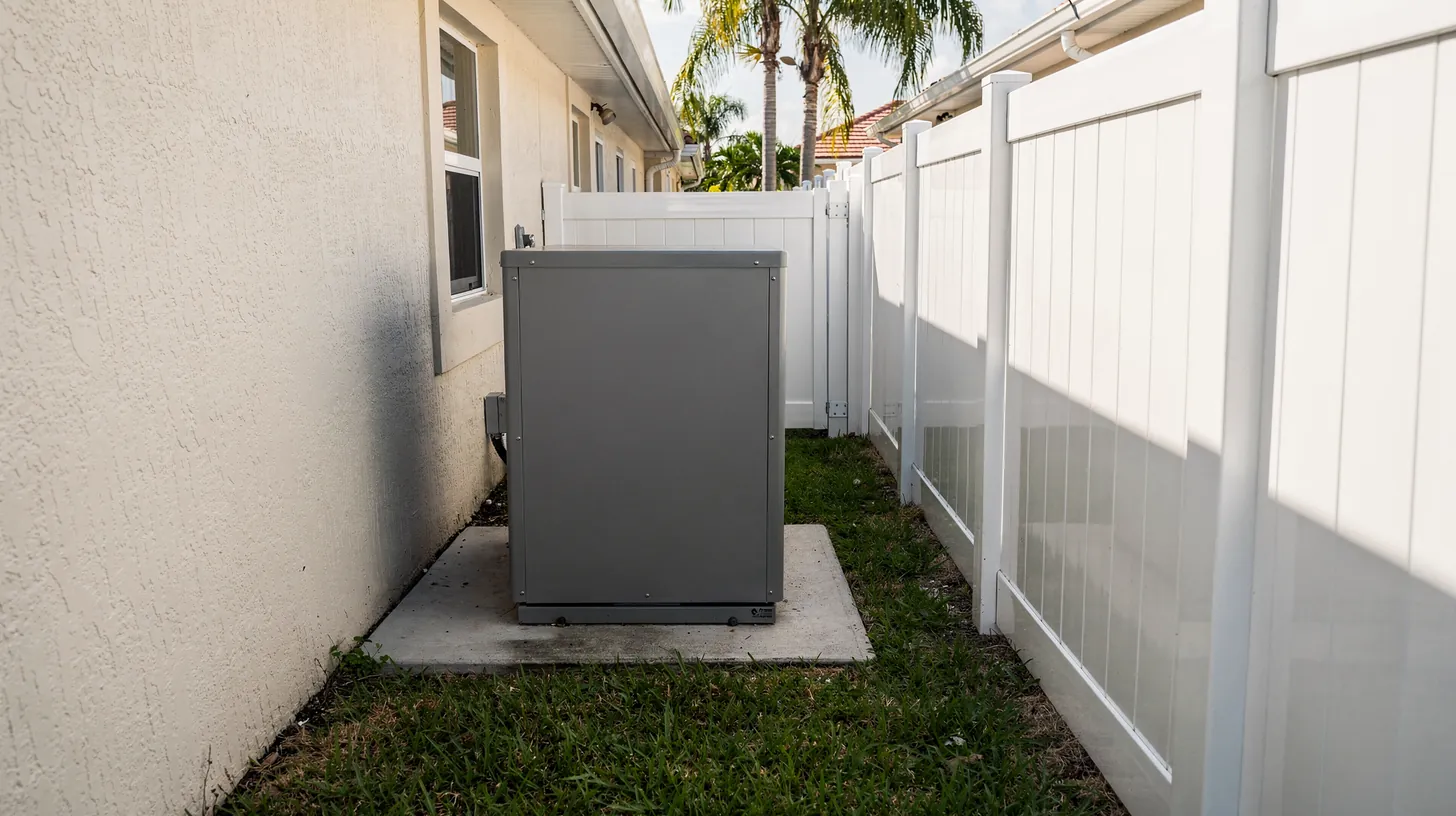
With the rear yard taken, the heat pump goes to a side yard, closer to a neighbor. Collier at least gives waterfront lots in its RSF-3 to RSF-6 districts a wider side yard, 10 feet against 7.5 (Collier County, 2026)2. Salt is the other waterfront cost: one manual says an oceanfront unit should sit out of direct sand and salt spray (Hayward Industries, 2023)13, and why pool equipment fails faster near the water covers corrosion and flood elevation.
What changes in a zero-lot-line home, a villa or a condo?
Collier's cluster rules allow a zero side yard on one side and require 10 feet on the remaining side (Collier County, 2026)4. The zero-lot-line wall may have no doors where it faces the adjoining lot, and a three-foot easement on the abutting lot is recorded for maintenance (Collier County, 2026)4. That leaves the wider side or the rear for pool equipment, with the next house close by.
The manufacturers' clearances then decide what fits. One manual asks for 24 inches on all sides as best practice and 72 inches of clearance under an overhang, allows as little as 6 inches to the coil from a wall or fence where the lot requires it, and says not to install within 24 inches of outdoor heating and air conditioning equipment (Hayward Industries, 2023)13. Another asks for 24 inches in front, 12 inches on the other sides and 6 inches from the house wall (Pentair, 2023)14.
Communities add their own layer. Marco Island's pool application warns that significant portions of the city are subject to deed restrictions that owners must research themselves (City of Marco Island, 2026)11. For gated communities, what an HOA asks for before a pool remodel explains the approval process.
What should you ask before an installer pours the pad?
Get the yard dimension from the lot's own zoning or development documents, not from memory. The county figures in this article are its base zoning district rules (Collier County, 2026)2, so if the lot is in a planned development, confirm the number in that development's documents. Ask the installer to mark the pad and its distance to each line on a site plan; Marco Island's pool application already asks for the equipment location (City of Marco Island, 2026)11.
Ask about night. A heat pump holding temperature through a cool spell may run through the night hours, when the limits are lowest, and how cold a Naples pool gets in winter shows when that happens. A unit that is undersized runs longer still, which why a pool heater cannot keep up explains. Schedules and time switches are covered in the energy code guide.
Ask what else is on that side of the house, because a heat pump beside the air conditioner is louder at the line than either alone (Federal Highway Administration, 2017)12. In the City, ask how the unit will be screened to its full height (City of Naples, 2026)6.
Settle all of it before the concrete. A pad poured in the wrong place is the expensive kind of mistake, and the equipment pad rebuild page covers what a well-laid-out pad looks like.
Ask Clayton
Questions this article usually prompts
Tap a question. Clayton replies himself, here and on the phone.
Tap a question to ask
If this is the situation you are in
Pool heat pumps, which genuinely work in this climate →Equipment pad rebuilds, so the next repair is a part swap →Gas pool heater installation, sized to the whole run →Pool heater repair in Naples, diagnosed not replaced →References
- Collier County Code of Ordinances, Chapter 54, Article IV, Noise (Collier County Noise Control Ordinance), secs. 54-82 to 54-93, Municode version of October 1, 2026, retrieved 15 November 2026
- Collier County Land Development Code 4.02.01, Dimensional Standards for Principal Uses in Base Zoning Districts (Table 2.1 and subsection D), Municode version of September 15, 2026
- Collier County Land Development Code 4.02.03, Specific Standards for Location of Accessory Buildings and Structures
- Collier County Land Development Code 4.02.04, Standards for Cluster Residential Design (zero lot line requirements)
- City of Naples Code of Ordinances, Chapter 22, Article II, Sec. 22-37 Noise, Municode version of November 12, 2026
- City of Naples Code of Ordinances, Chapter 56, Article II, Secs. 56-41 Mechanical equipment, 56-45 Pools and 56-54 Yards
- City of Naples Building Department, Installing Mechanical Equipment (Section 56-41 requirements), retrieved 15 November 2026
- City of Naples Building Department, Frequently Asked Questions: Do pool heaters require a permit?
- City of Marco Island Code of Ordinances, Chapter 18, Article IV, Noise Control (Ord. No. 24-15), secs. 18-101 to 18-108, Municode version of October 23, 2026
- City of Marco Island Land Development Code, Chapter 30, Article XVI, Secs. 30-1002 Accessory buildings and structures and 30-1004 Exceptions to required yards
- City of Marco Island Building Services, Pool Spa Fountain Permit Application, Form 13 (Building Services Forms), retrieved 15 November 2026
- Federal Highway Administration, Highway Traffic Noise Analysis and Abatement Policy and Guidance: Noise Fundamentals (updated August 24, 2017)
- Hayward Industries, HeatPro Heat Pump Installation and Operation Manual, 51300056501 Rev G (2023)
- Pentair, UltraTemp Heat Pump Installation and User’s Guide (2023)
- Pentair, UltraTemp HXi Inverter Heat Pump brochure L300331 (2022, Asia-Pacific)
The article is general.
Your pool is specific.
Tell us what the pool is doing, a sentence or two is enough. The person who wrote this is the person who calls back.